 DeadSea on Wiki Biblical Places Images

The
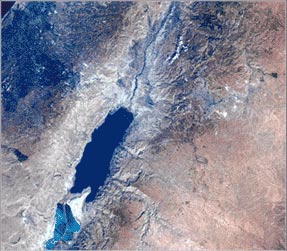
Dead Sea (
Hebrew:
יָם הַמֶּלַח,
Yām Ha-Melaḥ, "Sea of Salt";
Arabic:
البَحْر المَيّت,
al-Baḥr l-Mayyit, "Dead Sea";) is a
salt lake between
Israel and the
West Bank to the west, and
Jordan to the east. It is 422 metres (1,385 ft) below
sea level,
[2] and its shores are the lowest point on the surface of
Earth on dry land. The Dead Sea is 378 m (1,240 ft) deep, the deepest
hypersaline lake in the world. It is also one of the world's saltiest
bodies of water, with 33.7%
salinity. Only
Lake Assal (Djibouti),
Garabogazköl and some hypersaline lakes of the
McMurdo Dry Valleys in
Antarctica (such as
Don Juan Pond and perhaps
Lake Vanda) have a higher salinity. It is 8.6 times as salty as the ocean.
[3] This salinity makes for a harsh environment where animals cannot flourish, hence its name. The Dead Sea is 67 kilometres (42 mi) long and 18 kilometres (11 mi) wide at its widest point. It lies in the
Jordan Rift Valley, and its main
tributary is the
Jordan River.
Dead Sea, Jordan
Deep in the Jordan Valley and 55 km southeast of Amman, is the Dead Sea, one of the most spectacular natural and spiritual landscapes in the whole world. It is the lowest body of water on earth, the lowest point on earth, and the world's richest source of natural salts, hiding wonderful treasures that accumulated throughout thousands of years.
To reach this unique spot, the visitor enjoys a short 30 minutes drive from Amman, surrounded by a landscape and arid hills, which could be from another planet. En route a stone marker indicates "Sea Level", but the Dead Sea itself is not reached before descending another 400 meters below this sign.

The sunset touching distant hills with ribbons of fire across the waters of the Dead Sea brings a sense of unreality to culminate a day's visit to this region. It is normally as calm as a millpond, with barely a ripple disturbing its surface, but it can become turbulent. During most days, however, the water shimmers under a beating sun. Where rocks meet its lapping edges, they become snow-like, covered with a thick, gleaming white deposit that gives the area a strange and surreal sense.
Scientifically speaking, its water contains more than 35 different types of minerals that are essential for the health and care of the body skin including Magnesium, Calcium, Potassium, Bromine, Sulfur, and Iodine. They are well known for relieving pains and sufferings caused by arthritis, rheumatism, psoriasis, eczema, headache and foot-ache, while nourishing and softening the skin. They also provide the raw materials for the renowned Jordanian Dead Sea bath salts and cosmetic products marketed worldwide.

A unique combination of several factors makes Dead Sea's total attraction: the chemical composition of its water, the filtered sunrays and oxygen-rich air, the mineral-rich black mud along the shoreline, and the adjacent fresh water and thermal mineral springs.
Although sparsely populated and serenely quiet now, the area has a historical and spiritual legacy of its own. It is believed to be the site of five biblical cities: Sodom, Gomorrah, Admah, Zebouin and Zoar.
Dead Sea Also known as Bahr Lut, Eastern Sea, Lake of Asphalt, Salt Sea, “Sea of Sodom and Gomorrah,” Sea of the Arabah, Sea of the Devil, “Sea of the Plain,” Sea of Zoar, Stinking Lake |
|  |
| Names of the Sea Known in the Bible as the "Salt Sea" or the "Sea of the Arabah," this inland body of water is appropriately named because its high mineral content allows nothing to live in its waters. Other post-biblical names for the Dead Sea include the "Sea of Sodom," the "Sea of Lot," the "Sea of Asphalt" and the "Stinking Sea." In the Crusader period, it was sometimes called the "Devil's Sea." All of these names reflect something of the nature of this lake. |
| Biblical Period The Dead Sea, unlike the Sea of Galilee to the north, does not figure prominently in the biblical narratives. Its most important role was as a barrier, blocking traffic to Judah from the east. An advancing army of Ammonites and Moabites apparently crossed a shallow part of the Dead Sea on their way to attack King Jehoshaphat (2 Chron 20). Ezekiel has prophesied that one day the Dead Sea will be fresh water and fishermen will spread their nets along the shore. |
|   |
|  |
| Lowest Point The Dead Sea is located in the Syro-African Rift, a 4000-mile fault line in the earth's crust. The lowest point of dry land on earth is the shoreline of the Dead Sea at 1300 feet below sea level. That the lake is at the lowest point means that water does not drain from this lake. Daily 7 million tons of water evaporate but the minerals remain, causing the salt content to increase. Figures for the Dead Sea's salinity today range from 26-35%. |
| Mineral-Rich Nearly ten times as salty as the world's oceans and twice as saline as the Great Salt Lake in Utah, the Dead Sea is rich with minerals. The Dead Sea Works company on the southwest side of the lake employs 1600 people around the clock to harvest the valuable minerals from the water. Potash is the most valuable of those extracted today and is used in the manufacture of fertilizer. The best article on the minerals in the Dead Sea is in the Encyclopedia Britannica. |
|  |
|  |
| Healthy Water The unique concentration of the Dead Sea waters has long been known to have medicinal value. Aristotle, Queen of Sheba, King Solomon and Cleopatra were all familiar with this and modern doctors as well often prescribe patients with skin ailments to soak in the waters of the Dead Sea. Because of the dropping level of the Dead Sea, the southern end is no longer under water, except for that which is channeled by aqueducts for the purpos |


 Machtesh Ramon
 -MASADA ISRAEL-


![Reblog this post [with Zemanta]](https://lh3.googleusercontent.com/blogger_img_proxy/AEn0k_s-zfkKM7CWYq6o3bkxF_cl3x8wGGDNttdL5bKeLC5LvtVAuhJTnmvKCTJ6XWbKJ8L-Lh8mYmjfDbZuOh02tooJY2-PeasYzNXCNBFdO2AOaWHsyncX1dG4V1Fy28MXguEnIaFRzJeW4ra4mUkqCQ-X=s0-d)


